The Five Seconds That Change Everything on Thanksgiving
The conversation you avoid this week could cost you a decade of dignity. Why most families miss the warning signs hiding in plain sight at Thanksgiving.

It always happens in the doorway. Not at the dinner table and not during the toast. The real revelation of Thanksgiving - the one that often changes the future of a family - happens in the first five seconds after you arrive, when you finally see your aging parents up close.

Most of the year, we live on digital projections of the people we love. A weekly call, a text message, or a birthday Zoom, where everyone is well-lit and well-prepared. It creates a comforting illusion that everything is fine.
But Thanksgiving shatters that illusion. It brings reality back into full resolution. The slower walk, the clutter creeping across the counter, the moment of confusion before a familiar name clicks back into place.
Thanksgiving is America’s annual check-in on the health of its elders. And yet, most families miss the clues, either because they’re too focused on celebration, or because they don’t want to confront what those clues might mean.
Every year, behind the hum of football games and the clatter of dishes, a quieter set of conversations waits in the wings. They begin with small observations: “Mom’s handwriting looks different.” “Dad seems thinner.” “Grandma didn’t get up as quickly as she used to.” “Why does the house look harder to manage this year?”
Families notice these things, but rarely talk about them. Not because they don’t care, but rather, because they care too much. Asking the question feels like crossing a threshold: acknowledging that time is moving, roles are shifting, and the people who raised us may now need us.
But, Thanksgiving is the best, and sometimes the only, moment to begin these conversations before a crisis forces them on you.
There are now 63 million family caregivers in America, representing a 45% increase over the past decade, nearly one in four adults. More than half of Americans in their 40s find themselves sandwiched between aging parents and their own children, juggling two generations of care while maintaining careers and managing their own lives.
When the decline happens gradually, the denial becomes easy. It’s the quiet, ambiguous type of change that’s hard to measure: a misplaced bill, a forgotten medication, an unexplained dent in the car, a parent brushing off a minor fall as “nothing.” The medical world teaches us that aging rarely announces itself dramatically. Instead, it whispers. And Thanksgiving is the one holiday where adult children are close enough - and calm enough - to actually hear the whisper.
Early signs of Alzheimer’s and dementia include forgetting recently learned information, having trouble following familiar recipes or keeping track of bills, difficulty completing daily tasks, losing track of dates and seasons, and struggling to follow or join conversations. Rather than abstract medical symptoms, these are the small moments that happen between the stuffing and the pie, if we’re paying attention.
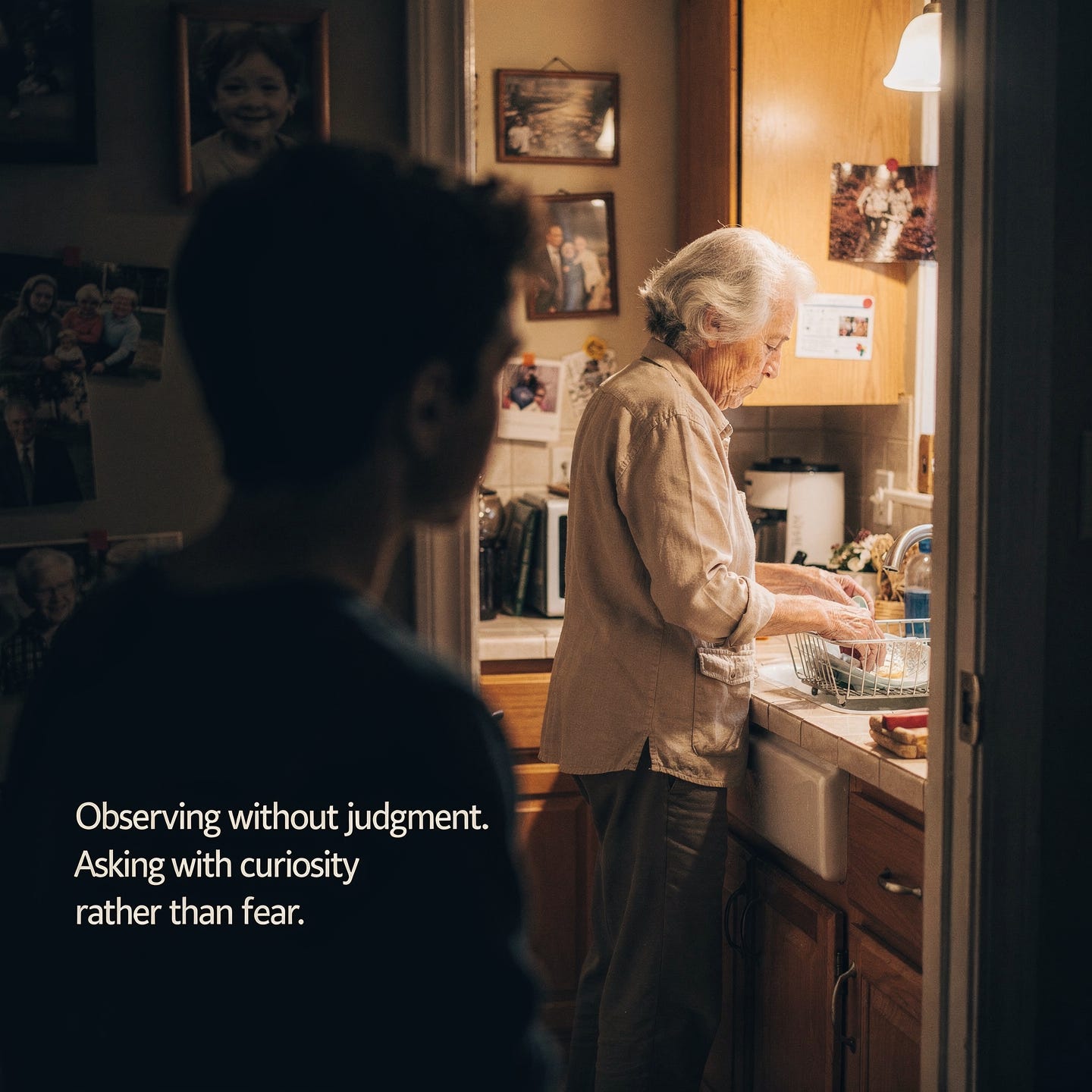
This doesn’t mean interrogating your parents between bites of turkey. It means practicing a different kind of presence. Observing without judgment. Asking with curiosity rather than fear. You don’t need to arrive with a checklist, but you just do the courage to ask: “How have things been feeling lately?” “What’s gotten harder?” “What would make life easier for you?” “Are you getting the support you need?”
Sometimes the answer will be reassuring. But sometimes, it will open a door that’s been quietly waiting to be opened.
Through my work running America’s fastest-growing eldercare platform CareYaya, I see this pattern repeatedly. Families frequently reach out to us after the holiday, not because something catastrophic happened, but because something small didn’t feel right. A daughter notices her mom is mixing up medications. A son realizes his father hasn’t been driving safely. A sibling sees their parent withdrawing, lonely, or overwhelmed by daily tasks. These are early-warning signs that allow families to intervene with compassion instead of panic.
The cost of avoidance is incredibly steep. The burden of waiting until crisis strikes - when options are limited and emotions are raw - creates trauma that reverberates through entire families. The families who check in early - who observe, ask, and act - navigate the next decade with far less chaos and far more dignity. The ones who avoid the conversation often find themselves blindsided later, when the stakes are higher, the decisions harder, and the options fewer.
Thanksgiving isn’t just a time to be grateful. It’s a time to be perceptive. To notice what’s easy to overlook, and to honor the people who built your life by understanding the new shape of theirs.
This year, don’t just carve the turkey. Carve out the conversation. Your future self, and your future family, will thank you for it.
Neal K. Shah is a health care researcher specializing in caregiving, workforce innovation, and artificial intelligence. He is the Principal Investigator of the Johns Hopkins YayaGuide AI for Caregiver Training project. Neal also serves on North Carolina’s Steering Committee on Aging. He is CEO of CareYaya Health Technologies.
Great insight. What if families opened that conversation?
Thank you for sharing this. I was just thinking about this today- when we see our aging parents at the holidays it’s an opportunity to ask some thoughtful questions and watch what’s really going on. It’s hard sometimes because you want to enjoy the holidays, not bring stress. I loved your helpful context.