America Built a Care System That Requires Infinite Children. We're Out.
We built a care system on the assumption that families were infinite. They're not.

It was the unopened mail that got me. Sitting in a kitchen, watching an elderly woman try to explain why three months of bills were stacked on the counter still in their envelopes. She wasn’t confused. She wasn’t sick yet. She was just alone, and the alphabet soup of insurance codes and payment deadlines had become a language she didn’t speak anymore. The light through the window was the same light she’d woken up to for decades. But everything else had quietly rearranged itself.
As a health care researcher studying caregiving, I’ve spent the past few years building and evaluating new care models like CareYaya that pair trained college students to care for older adults at home. I see our country’s demographic change not as an abstraction but as a daily reality. In thousands of home visits each month through the CareYaya platform, a story keeps repeating itself: families are simply running out of hands and our nation’s traditional support systems are buckling under demographic pressure.

I started noticing this everywhere once I looked. The 39-year-old dropping her toddler at daycare, then driving forty minutes to sit with her father through a neurology appointment, then dialing into a work call from the hospital parking lot with her hands still shaking. The HR manager who lost her best employee not because the job was bad, but because overnight care coverage doesn’t exist at a price a middle-class family can afford. The county planning meetings where people argue about bike lanes while half the town ages into eligibility for a paratransit system that nobody’s bothered to fund yet.
Through CareYaya’s collaborations with health systems, policymakers, and university researchers, I’m seeing the same exact pattern emerge everywhere: the demand for care across America is accelerating MUCH faster than the supply of family members who can provide it. We recently discussed this on the Positive Aging podcast along with the finalists of the National Institute on Aging (NIA) Startup Challenge.
The “sandwich generation” used to be a metaphor. Now it’s a calendar entry: Kid’s school pickup at 3:15. Mom’s neurology appointment at 4:00. Work Zoom at 5:30. Rush to the pharmacy before it closes. Nearly half of working caregivers say flexible schedules are the benefit they value most, because time is the currency they are running out of. And behind the logistics lives a question nobody wants to say out loud: What happens when there’s nobody left to call?
This isn’t a culture war but just plain math.
By 2034, for the first time in American history, adults over 65 will outnumber children under 18. Seventy-seven million older adults. Seventy-six million kids. The demographic pyramid is flipping, and we are still pretending it hasn’t. The U.S. fertility rate dropped to an all-time low of 1.6 children per woman in 2024 — well below the replacement rate of 2.1. We are living longer, having children later, and compressing all the care responsibilities into the same brutal decade of a single generation’s life.
In eleven states, older adults already outnumber young children. Soon, that inversion will spread county by county, school board by school board, rewriting budgets and redefining what it means to be a working adult in America. This isn’t a theory but the actual births and birthdays we have already lived.
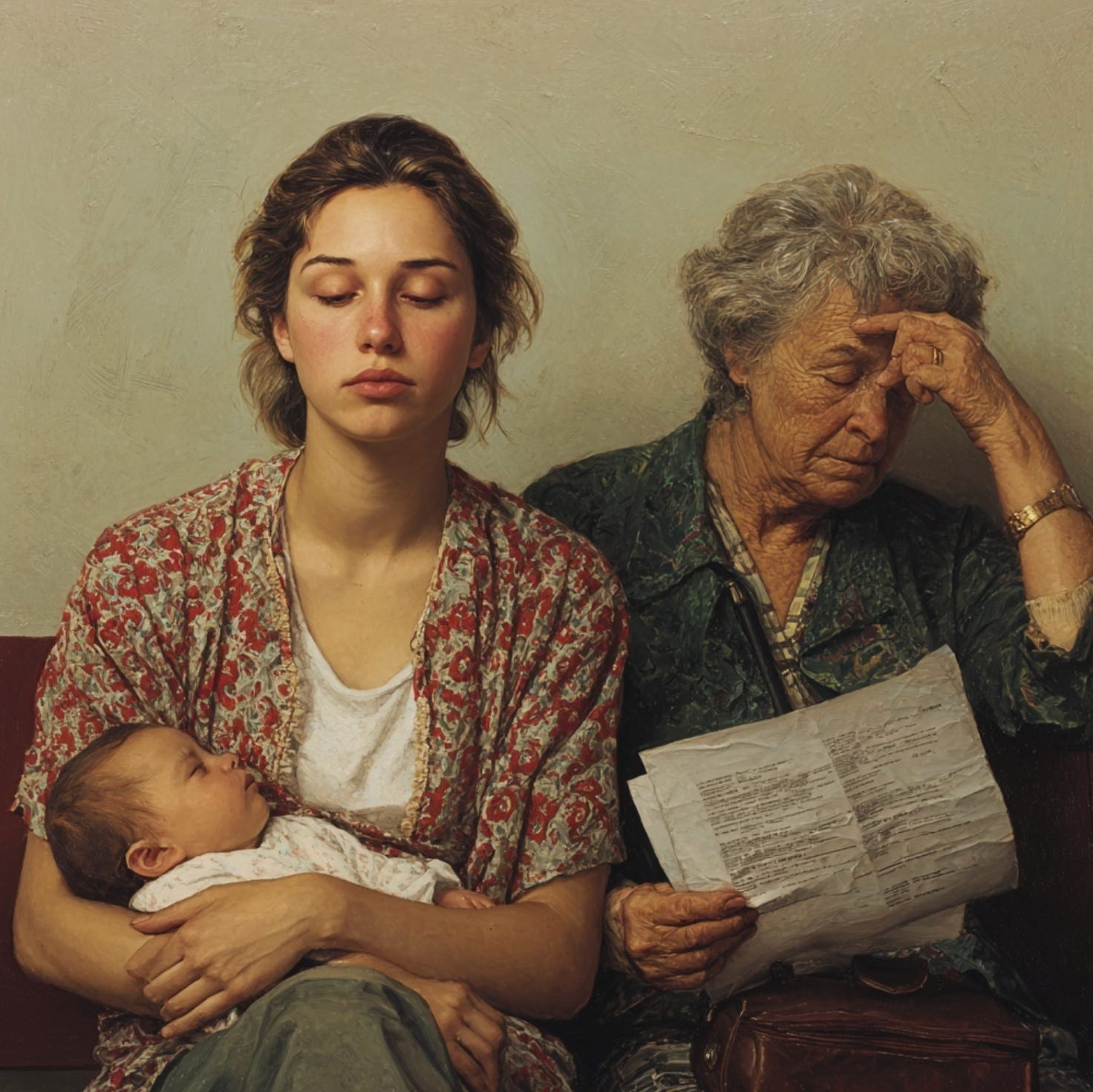
Meanwhile, 63 million Americans provided unpaid care in the last year. That’s nearly one in four adults — helping a parent with bathing, a partner with cancer, a child with a complex condition. Economists estimate the market value of that labor at $870 billion a year, a shadow system larger than many industries and almost entirely invisible in our GDP calculations. We have built a health system that assumes families will always absorb the overflow. Those families are struggling right now.
Still, the government pretends this is a private matter. Employers treat elder care as an after-hours issue. Policy has not caught up. State budget officers see the cliff ahead — smaller youth cohorts entering the workforce, older cohorts claiming the benefits they earned. Fewer workers carrying more obligations: Social Security and Medicare on one side, schools and childcare on the other, long-term care costs rising through the middle. The old social contract assumed a broad base of young workers. We are building tomorrow’s safety net with fewer beams.
Maybe that’s the real lie: that any of this was sustainable without a plan.
There’s another story folded into these numbers, one we rarely name: the rise of aging alone. More than a quarter of older Americans live by themselves. Many are women who have outlived spouses and siblings. Independence can be a source of pride. But it can also mean isolation. Falls that no one witnesses. Paperwork that no one understands. A pile of unopened envelopes on the kitchen table. When we talk about “aging in place,” we should remember that “place” is often a one-bedroom apartment with a broken latch and a calendar full of white space.

I think about the son who googled “UTI delirium” at 2 a.m. I think about the manager who couldn’t find overnight care coverage for her father and watched her career stall. I think about the sandwich generation — not the bumper sticker version, but the 47% of caregivers under 50 who are simultaneously caring for children and adults, spending an average of $7,200 per year out of pocket, or about one-quarter of their annual income, on someone else’s survival. This is the structural reality we’ve baked into the system. And we are asking people to endure it quietly, as if endurance were the same thing as care.
What would it look like to treat caregiving as infrastructure?

First, standardize paid family caregiving leave nationwide. Workers use it. It keeps them employed. It buys time when time is most scarce. Second, fund the home care workforce like the life-support system it is: higher Medicaid rates tied to wage floors, portable credentials, visas to encourage immigration for trained aides. Area Agencies on Aging will tell you bluntly that fast-food wages routinely beat home care pay, and burnout follows. Third, make the tax code acknowledge reality. Call it a refundable caregiver credit and index it to intensity of care.
Fourth, face immigration with a clear eye. In a graying nation, newcomers keep communities young enough to work, to pay taxes, to raise the next cohort of caregivers. Census estimates show immigration is already the engine of population growth as the country ages. It’s not a shortcut but the practical difference between managing the demographic inversion and heading into societal collapse.
Finally, insist on human-centered technology. Sensors, AI scheduling, remote monitoring — these can buy back hours, but only if they add human time, not take it away. Families need care navigation as much as they need gadgets: clear benefits, trusted respite, a reliable person who shows up. When logistics finally get out of the way and the conversation can begin, everything downstream — the hospitalizations, the burnout, the workplace strain — begins to ease.
We have time to choose the country we will be when the age pyramid flips.
We can invest now in the caregivers who hold up both ends of the life course, or we can wait and pay later in churn, in lost productivity, in emergency room admissions that were neither inevitable nor merciful. The math is already written. The births have already happened. The only question left is whether we meet it with policy, with employers who stop pretending, and with communities that choose to keep each other company in the long middle.

The mail is still sitting on the counter. Someone will need to open it eventually.
The question is whether anyone will still be there when it’s time.
Neal K. Shah is a health care researcher specializing in caregiving, workforce innovation, and artificial intelligence. He is the Principal Investigator of the Johns Hopkins YayaGuide AI for Caregiver Training project. Neal also serves on North Carolina’s Steering Committee on Aging. He is CEO of CareYaya Health Technologies.
Holy shit - what a write-up.
The pile of unopened letters is heavy. It’s not just the physical, mental, and emotional caregiving responsibilities - there’s a huge component that is also financially and administratively responsible. The world is getting more complex - much more so for older people. Staying on top of things on behalf of our parents is another burden for the sandwich generation. Do you know how much of a headache it will be if my elderly father-in-law gets scammed?
When you’re a child of immigrants (Asians consider the children the first-generation, whereas some other cultures consider themselves immigrants the first-gen, but I digress) - taking care of your parents is a thing you learn at a young age. Translating tax documents, taking phone calls from bill collectors, setting up the family computers… these are all things I learned when I was young. I imagine a lot of folks will be doing that again as the elders become more dependent on their children.
Anyway, this is a great callout and also offers some interesting cultural dynamics we need to consider as a society. Can’t wait for 2034 I guess.